How Long Does a Furnace Last in Pittsburgh, PA?
If your furnace is getting up in years, you are probably asking a very reasonable question — how much life is left in it, and when should you start thinking about replacement? It is a question our Pittsburgh HVAC team hears regularly, and the honest answer depends on several factors that are specific to your system, your home, and how consistently the furnace has been maintained over the years.
Here is what Pittsburgh homeowners should know about furnace lifespan — and how to tell when your system is approaching the end of its reliable service life.
The Average Furnace Lifespan in Pittsburgh PA
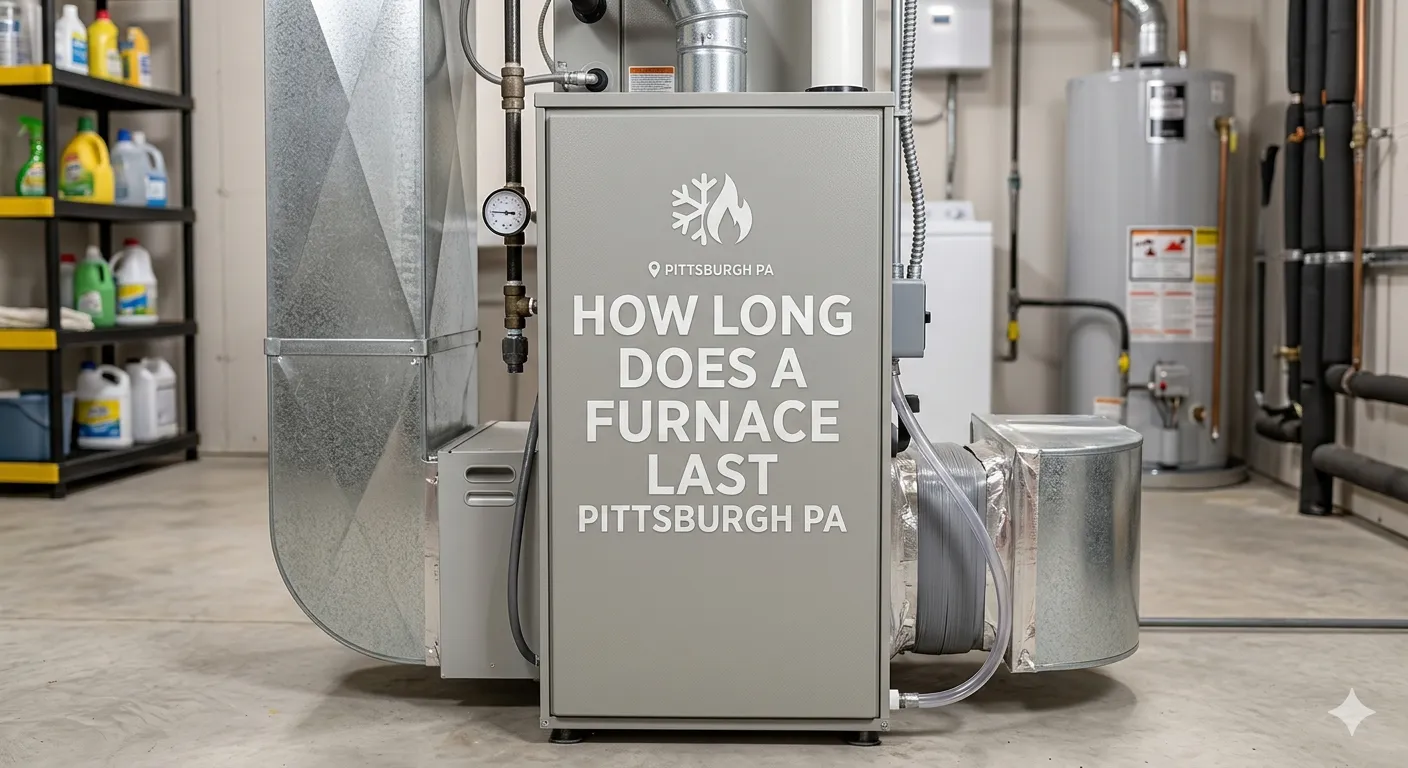
Most residential furnaces in Pittsburgh deliver reliable service for 15 to 20 years when they are correctly installed, professionally maintained on an annual schedule, and repaired promptly when issues arise. Systems that hit all three of those marks consistently tend to reach the upper end of that range. Systems that miss annual maintenance, operate with restricted airflow from clogged filters, or accumulate minor unresolved faults tend to fall short of it.
Pittsburgh’s climate plays a direct role in how hard a furnace works over its lifetime. The heating season in Pittsburgh runs from late October through March in most years — six months of sustained demand that accumulates real operational wear. A Pittsburgh furnace logs significantly more annual heating hours than a system in a milder climate, which is one reason why consistent annual professional maintenance is more valuable here than in warmer parts of the country.
Fuel type also influences lifespan in a meaningful way. Gas furnaces in Pittsburgh typically fall within the 15 to 20-year range with proper maintenance. Electric furnaces tend to last somewhat longer, often reaching 20 to 30 years, because they lack combustion components that wear and degrade over time. Oil furnaces, common in Pittsburgh’s suburban and older neighbourhoods, sit closer to the 15 to 25 year range, depending on maintenance history and fuel quality.
Factors That Affect How Long Your Pittsburgh Furnace Lasts
Annual professional maintenance. This is the single most influential factor in furnace lifespan across Pittsburgh homes. A furnace that receives consistent professional servicing every year — with burner cleaning, heat exchanger inspection, blower motor service, and safety system testing — operates at closer to its rated efficiency and accumulates wear more gradually than a system that goes years without professional attention. The difference between a maintained and unmaintained furnace over a 20-year period is often several years of additional reliable service.
Installation quality. A furnace that was incorrectly sized for your Pittsburgh home, improperly piped, or inadequately commissioned at installation operates under stress from day one. Correct sizing in particular has a profound long-term impact — an oversized furnace short-cycles repeatedly, turning on and off without completing full heating cycles, which accelerates wear on the igniter, heat exchanger, and blower motor components that control every startup. A professionally sized and installed furnace simply lasts longer than one that was not.
Visit the furnace installation guide.
Filter maintenance. The air filter is the furnace component that Pittsburgh homeowners have the most direct control over — and neglecting it has real consequences. A clogged filter forces the furnace to draw air through increasingly restricted channels, raising internal temperatures, stressing the heat exchanger, and working the blower motor harder than its design tolerates. Replacing your filter every one to three months during the heating season — more frequently in households with pets or multiple occupants — is one of the most straightforward things a Pittsburgh homeowner can do to protect furnace longevity.
Prompt repairs when issues arise. A furnace that develops a minor fault and continues operating with that fault unaddressed is a furnace that accumulates secondary damage. A failing igniter causes repeated hard start attempts that stress other components. A heat exchanger developing a hairline crack continues to expand under thermal cycling. A blower motor bearing showing early wear accelerates toward failure. Pittsburgh homeowners who address developing faults promptly consistently get more total service life from their furnaces than those who delay repairs until the system becomes completely non-functional.
Signs Your Pittsburgh Furnace Is Approaching End of Life
Knowing the warning signs that a furnace is entering its final years helps Pittsburgh homeowners plan a replacement on their own terms — rather than being forced into an emergency purchase in the middle of January.
Your system is 15 years old or approaching it. Age alone is the most reliable indicator. A furnace at 15 years has used the majority of its expected service life and is entering the period where component failures become more frequent and less predictable. It does not mean replacement is immediately necessary, but it does mean a professional assessment is worth scheduling to understand the system’s current condition and remaining useful life.
Your repair frequency is increasing. A furnace that needed one repair in a heating season two years ago, two repairs last year, and has already needed attention once this season is showing a pattern of accelerating decline. When repair frequency climbs, cumulative repair spending over the next few seasons often approaches or exceeds the cost of a replacement that would have delivered years of trouble-free service.
Your energy bills are rising without explanation. An aging furnace working harder to produce the same level of heat as its efficiency declines consumes progressively more fuel. If your heating bills have been climbing season over season without a corresponding increase in usage or fuel prices, your furnace is almost certainly the cause. A modern high-efficiency replacement typically pays back part of the upfront cost through energy savings within the first few years of operation in Pittsburgh’s extended heating season.
Your home heats unevenly. Cold rooms, spaces that take much longer to reach comfortable temperatures, or a furnace that runs continuously without achieving your set temperature all indicate a system that can no longer distribute heat effectively throughout your Pittsburgh home. This can result from aging components, ductwork issues, or a furnace that has declined past the point where it can meet the demand it was originally sized for.
You are facing a significant repair on an aging system. When a furnace that is already 15 or more years old requires a repair quoted at a significant portion of what a comparable new system would cost, the financial case for replacement over repair becomes compelling. The general threshold most HVAC professionals apply is this: if a single repair on an aging system is quoted at 50 percent or more of replacement cost, replacement almost always delivers better long-term value.
How to Extend Your Pittsburgh Furnace’s Lifespan
The most reliable things Pittsburgh homeowners can do to get the maximum service life from their furnace are also the most straightforward. Schedule professional annual maintenance every autumn before the heating season begins. Replace your air filter every one to three months during the heating season. Address developing faults promptly rather than operating through them. Keep the area around your furnace clear of stored items and debris. And test your system in October each year before the cold arrives — so any developing issue is discovered with time to address it, rather than during the first cold snap.
None of these steps are complicated, and none of them are expensive relative to the cost of an emergency replacement or a major repair that could have been caught earlier.
When Should Pittsburgh Homeowners Start Thinking About Replacement?
The right time to begin thinking seriously about furnace replacement is when your system reaches 15 years old — not because it will necessarily fail at that point, but because that is when a professional assessment of its current condition, remaining efficiency, and likely repair trajectory becomes genuinely useful for planning purposes.
An honest assessment from a qualified Pittsburgh HVAC technician at that stage tells you whether your system is in good shape for several more years, approaching the point where replacement makes more financial sense than continued repair, or already past the point where investment in repairs is hard to justify. That information — gathered proactively rather than reactively — gives Pittsburgh homeowners the time to choose the right replacement system without pressure, compare options, arrange financing, and schedule installation at a convenient time rather than under emergency conditions.
If your Pittsburgh furnace is approaching 15 years, has been showing declining performance, or has needed multiple repairs in recent seasons, our Pittsburgh heating team is happy to provide an honest assessment of your system’s condition and remaining service life.